

SUCHE
ANZEIGEN











Unabhängige Nachrichten, Berichte & Meinungen

Filmclips
NEUTRALITÄT & NAM ::: Non-Alignment Movement ::: Bewegung der Blockfreien
Von Global Women for Peace United Against NATO (GWUAN)
https://www.youtube.com/watch?v=kYv5d3y_JCUkYv5d3y_JCU
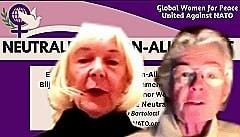 Wir untersuchen Ideen für eine fortschrittlichere Zukunft und befassen uns näher mit Neutralität und Blockfreiheit. Neutralität ist ein komplexes Thema. Die Suche nach einer gemeinsamen Sicherheitsstruktur und der überwältigende Wunsch der Menschen nach friedlicher Zusammenarbeit zwischen souveränen Staaten, nach Zusammenarbeit statt Konkurrenz und nach öffentlichen Ausgaben für menschliche und planetarische Bedürfnisse statt für Kugeln und Bomben veranlassen uns, mit einer fortschrittlichen Vision in das Jahr 2026 zu gehen.
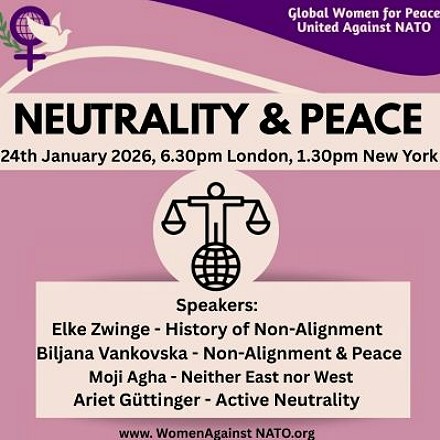
Beteiligte:
- Pippa Bartolotti: Kurze Einführung und Moderation, The United National Antiwar Coalition (UNAC)
- Elke Zwinge: Geschichte der Blockfreiheit. Mitglied des Deutschen Friedensrats und Delegierte des Weltfriedensrats in China, Vietnam und Venezuela
- Biljana Vankovska: Blockfreiheit und Frieden. Professorin für Internationale Beziehungen und Friedensforschung aus Mazedonien, Vorstandsmitglied der Transnational Foundation for Peace and Future Research (Lund), Mitglied des Kollektivs No Cold War
- Moji Agha: Weder Ost noch West. Sufi-Mönch mit 40 Jahren Berufserfahrung, klinischer und akademischer Forschung in Verhaltens-, Kultur- und Ökologiestudien mit Schwerpunkt auf Konfliktverständnis und Heilung
- Ariet Güttinger: Aktive Neutralität. Historikerin und Psychologin, Vorstandsmitglied der Schweizerischen Bewegung für Neutralität.
Aktionspunkte und Zusammenfassung: 5 Minuten
Elke Zwinge
HISTORY OF THE NON-ALIGNED MOVEMENT (NAM)
The history of the Non-Aligned Movement spans a long period of time. It began during the Cold War in a bipolar world and has led to the development of multipolarity since the beginning of the millennium. In brief, I will mention
- the basic principles and guidelines of the NAM ,
- some summit meetings,
- the cooperation of the NAM with other organisations
- conclusions for us as a peace movement
The colonies were clearly excluded from these obligations under international law! They intensified their struggle for independence and liberation!
In 1955, the first anti-colonial conference took place in Bandung, Indonesia. Representatives from 29 Asian and African states came together. Its participants represented empires, republics and communist countries. Some countries were formally independent, others still under colonial rule. Despite their political diversity, they were united in their rejection of colonialism, racism and nuclear armament. The most prominent representatives were Sukarno from Indonesia, Zhou Enlai from China, Nasser from Egypt, Nehru from India and Nkrumah from Ghana. Similar to the Charter of the United Nations, they emphasised sovereignty, territorial integrity, equality, non-interference and renunciation of aggression as the basis for peaceful coexistence.
In the spirit of Bandung, the above-mentioned leaders – with the exception of Zhou Enlai – met again in Belgrade in 1961 on Tito's initiative.
In 1961, the world was divided into two camps: With the founding of NATO in 1948, the USA led the Western power bloc. Faced with forced confrontation with its ideological opponent, the Soviet Union, the latter founded the Warsaw Pact in 1955.
As a counterweight, NAM positioned itself neutrally outside the confrontation between the two military blocs.
It wanted to pursue its own political, economic and cultural path. The five principles of peaceful coexistence developed in Bandung were fundamental. Describing their organization as a movement characterises its openness and willingness to discuss different positions.
Some examples of summit meetings that are historical snapshots:
Lusaka Summit 1970
The member nations added as aims of the movement the peaceful resolution of disputes and the abstention from the big power military alliances and pacts, opposition to stationing of military bases in foreign countries. The more than 900 US military bases, most of them in countries of the South, contradict the NAM principle of neutrality
The Algiers Summit 1973
a few days before the coup in Chile and the US ceasefire with North Vietnam Condemnation of the US military presence and interference in the internal affairs of the peoples of Indochina. Reform of the world trade system. Independent control over multinational corporations, own rights over profits and marketing of resources. In accordance with Article 1 of the UN Social and Civil Covenant of 1966.
The summit in New Delhi 1983
Increase in bilateral conflicts. Differences between oil-exporting and non-oil-exporting countries. Economic dependence on one power or another.
The summit in Jakarta 1992
Call for nuclear disarmament. The UN is obliged to enforce all disarmament treaties. What a pity: There is openness to The Hague Appeal for ‘responsibility to protect’.
The summit in Kampala 2024
At the same time as the G77 in Kampala, Uganda Both organizations strongly condemn Israel's actions against Palestine. The UN is called upon to take action. South Africa's lawsuit against Israel is filed with the International Court of Justice. The Group of 77 is founded 1964. Its goal: to strengthen South-South cooperation and improve the position of developing countries in the world market. It is the largest group within the UN, actually with 124 members. NAM 120 members. Both organizations cooperate intensively.
At the beginning of the 21st century, Latin America is becoming increasingly independent from its status as the backyard of the USA. With the Bolivarian Revolution under Chavez, the first steps towards a multipolar world are being taken. Foundation of the ALBA organization, Bolivarian Alternatives for Our America.
Foundation of CELAC as a subcontinent of peace
Following NAM presidents support the emancipation of an united global south: Nelson Mandela, Thabo Mbeki, Fidel Castro, Raul Castro, Nicolas Maduro
The development of a multipolar world through the following organizations, alliances and platforms:
- In Asia: Shanghai Cooperation Organization and ASEAN
- In Africa: African Union, Alliance of Sahel States, AES concentrated on Pan-Africanism
- Cross-continental: BRICS and G77
The BRICS countries in particular follow the maxim that they are NOT Western, but NOT ANTI-Western. Countries of the global South and East cooperate with countries of the collective West for mutual benefit. One example is the New Silk Road. Their infrastructure projects follow the principle of peace through development.
The NAM is also changing its position of non-alignment to the norm of multi-alignment in the sense of broad cooperation.
Indonesia, Turkmenistan and Vietnam officially describe themselves as neutral.
Non-alignment and neutrality were handled differently by the presidents at the summit meetings: Indonesia under Suharto (1992). Close relationship with the USA. Worst massacre of communists in 1962. Cuba (1979, 2006) saw the Soviet Union as a partner of the countries of the South. Venezuela (2016) sees Russia and China as partners
The principle of neutrality is not ideologically defined, i.e. socialist or capitalist. It primarily means not making one's territory available to either power bloc for military or occupation purposes.
For the anti-colonial and anti-imperialist NAM movement, neutrality is a statement that the military should only be used for defense. In this respect, NAM is a source of inspiration for us.
When asked whether NAM still has any significance, a Chinese broadcaster answered in 2025: „Yes! Powerful countries are still pushing bloc-confrontation. The global South is still facing economic and political pressure. It is more imperative to strengthen solidarity and cooperation to make the global government system giving the development countries united front and platform for pushing back.“
This leads me to the idea of a global class struggle: Countries of the South that promote peaceful development and we as anti-NATO peace activists round the world stand together against war-mongering NATO states that want to maintain and expand their unipolar world.
We who defend the UN Charter are an active part of a multipolar, peaceful world. And that world belongs to women and men. At the NAM summits, I have seen too many men...
Ariet Güttinger on Switzerland's neutrality
ACTIVE NEUTRALITY
In 1907, Switzerland signed the Hague Convention on Land Warfare. This means that Switzerland is bound by international law to remain neutral. What does this mean for Switzerland?
- A neutral state does not participate in wars.
- A neutral state defends itself with armed forces.
- A neutral state does not provide mercenaries to the warring parties
- A neutral state does not make its territory available to the warring parties
How is Switzerland's neutrality perceived abroad today? As a neutral country, Switzerland actually has a duty to call on countries involved in armed conflicts to abide by the UN Charter and international humanitarian law, to negotiate and to offer its good services. This has not been the case since the war between Ukraine and Russia.
- Since 2022, the Swiss Federal Council (executive branch) has adopted sanctions against Russia that violate international law.
- The Federal Council and Parliament want to align themselves with NATO and the EU in terms of security policy.
- Federal Councillor Cassis has sided with Israel in the Israel-Palestine conflict.
Neutrality was such a matter of course in Switzerland that it was mentioned in the constitution but never formulated in detail or embedded in it. As the Federal Council has been disregarding neutrality for some time now, we want to enshrine neutrality in the Federal Constitution in a concrete and differentiated manner by means of a popular initiative.
The new constitutional article, which the Swiss people will vote on next year, reads as follows:
- Federal popular initiative “Preservation of Swiss neutrality (neutrality initiative)” Art. 54a2 Swiss neutrality
1 Switzerland is neutral. Its neutrality is perpetual and armed.
2 Switzerland shall not join any military or defense alliance. Cooperation with such alliances is reserved in the event of a direct military attack on Switzerland or in the event of actions in preparation for such an attack.
3 Switzerland shall not participate in military conflicts between third countries and shall not take non-military coercive measures against belligerent states. This does not apply to obligations towards the United Nations (UN) or to measures to prevent the circumvention of non-military coercive measures by other states.
4 Switzerland uses its perpetual neutrality to prevent and resolve conflicts and is available as a mediator. This year, the Swiss people will be able to vote on the neutrality initiative. This initiative specifically obliges the Federal Council to pursue a neutral foreign policy that is also perceived as such internationally.
Ariet Güttinger zur Neutralität der Schweiz
AKTIVE NEUTRALITÄT
1907 hat die Schweiz das Haager Landkriegsabkommen unterzeichnet. Damit ist die Schweiz völkerrechtlich zur Neutralität verpflichtet. Was bedeutet das für die Schweiz?
- Der neutrale Staat nimmt nicht an Kriegen teil
- Der neutrale Staat verteidigt sich bewaffnet
- Der neutrale Staat stellt den Kriegsparteien keine Söldner zur Verfügung
- Der neutrale Staat stellt den Kriegsparteien sein Staatsgebiet nicht zur Verfügung
Wie wird heute die Neutralität der Schweiz im Ausland wahrgenommen? Als neutrales Land hätte die Schweiz eigentlich die Aufgabe, bei kriegerischen Auseinandersetzungen die Länder dazu aufzurufen, sich an die Uno-Charta und an das Humanitäre Völkerrecht zu halten, zu verhandeln und seine Guten Dienste zur Verfügung zu stellen. Seit dem Krieg zwischen der Ukraine und Russland ist das nicht mehr der Fall.
- Der Schweizer Bundesrat (Exekutive) hat seit 2022 völkerrechtswidrige Sanktionen gegen Russland übernommen
- Bundesrat und Parlament wollen sich sicherheitspolitisch der Nato und der EU annähern.
- Bundesrat Cassis hat sich in der Frage Israel-Palästina auf die Seite Israels gestellt.
Wie können wir unsere gewählten Parlamentarier wieder zu einer neutralen Außenpolitik verpflichten? Was können wir tun, damit wir den guten Ruf der Schweiz wieder herstellen können? Die Neutralität war in der Schweiz eine solche Selbstverständlichkeit, dass sie in der Verfassung zwar erwähnt, aber nie im Detail ausformuliert und verankert worden ist. Da der Bundesrat seit einiger Zeit die Neutralität missachtet, wollen wir jetzt die Neutralität mit einer Volksinitiative konkret und differenziert in der Bundesverfassung verankern.
Der neue Verfassungsartikel, über den das Schweizer Volk im nächsten Jahr an der Urne abstimmen wird, lautet wie folgt:
- Eidgenössische Volksinitiative 'Wahrung der schweizerischen Neutralität (Neutralitätsinitiative)’ Art. 54a2 Schweizerische Neutralität
1 Die Schweiz ist neutral. Ihre Neutralität ist immerwährend und bewaffnet.
2 Die Schweiz tritt keinem Militär- oder Verteidigungsbündnis bei. Vorbehalten ist eine Zusammenarbeit mit solchen Bündnissen für den Fall eines direkten militärischen Angriffs auf die Schweiz oder für den Fall von Handlungen zur Vorbereitung eines solchen Angriffs.
3 Die Schweiz beteiligt sich nicht an militärischen Auseinandersetzungen zwischen Drittstaaten und trifft auch keine nichtmilitärischen Zwangsmaßnahmen gegen kriegführende Staaten. Vorbehalten sind Verpflichtungen gegenüber der Organisation der Vereinten Nationen (UNO) sowie Maßnahmen zur Verhinderung der Umgehung von nichtmilitärischen Zwangsmaßnahmen anderer Staaten.
4 Die Schweiz nutzt ihre immerwährende Neutralität für die Verhinderung und Lösung von Konflikten und steht als Vermittlerin zur Verfügung. In der Schweiz wird das Volk in diesem Jahr über die Neutralitätsinitiative abstimmen können. Sie verpflichtet den Bundesrat ganz konkret, eine neutrale Außenpolitik zu verfolgen, die international auch als solche wahrgenommen wird.
Clip downloaden (mit Rechtsklick - "Ziel speichern unter...")
Online-Flyer Nr. 858 vom 15. September 2026

NEWS
KÖLNER KLAGEMAUER

Für Frieden und Völkerverständigung
FILMCLIP
FOTOGALERIE


ANZEIGEN